

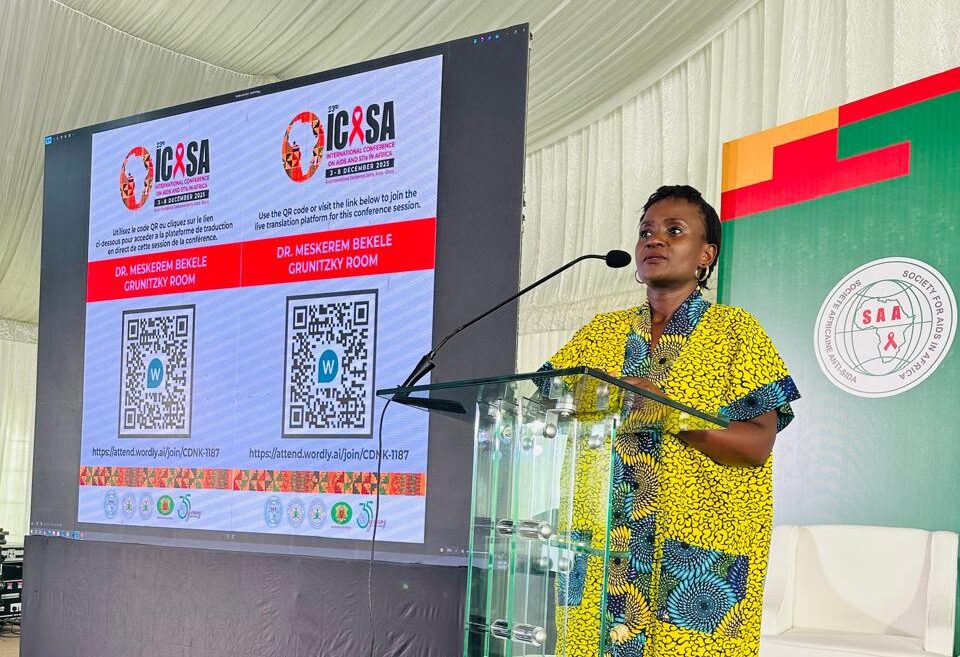
In early December, the 23rd International Conference on AIDS and STIs in Africa, ICASA 2025, was held in Ghana. With over 10,000 participants from nearly 150 countries, the six-day conference, held from December 3 to 8, highlighted the theme Africa in Action: Catalyzing Integrated Sustainable Responses to End AIDS, TB & Malaria.
Violet Oramisi, MBChB, MSc, CQUIN’s regional strategic information advisor, gave a presentation on the potential efficiencies of differentiated service delivery (DSD) for family planning as part of a satellite session organized by the International AIDS Society (IAS) on “The Future of Differentiated HIV Services.” She also joined sessions across a wide range of scientific, clinical, prevention, leadership, and community topics.
In this Q&A, Dr. Oramisi reflects on key takeaways from ICASA 2025 and discusses where she sees opportunities for CQUIN to support countries as they consider expanding DSD while grappling with current funding realities.
Q: What aspect of ICASA 2025 made the biggest impact on you?
What stood out immediately was the range of innovations being presented from across Africa. For example, the first HIV cure clinical trial conducted on the continent was presented from South Africa, where a small study in Durban explored immunotherapy approaches in virally suppressed recipients of care. New diagnostic technologies were highlighted, including AI-supported radiology from Nigeria, which showed improved detection of pulmonary tuberculosis (TB) in people living with HIV, and the expanded use of TB LAM testing in South Africa and Malawi.
There were also presentations from Ghana, where researchers from the Noguchi Memorial Institute shared findings on plant-based compounds with anti-HIV potential, as well as studies from Cameroon and Nigeria examining immune responses in HIV co-infections, including TB and mpox. Alongside these innovations, many sessions were very open about ongoing challenges related to sustainability, funding, and implementation, which made the discussions feel grounded in the current context.
Q: You presented on differentiated service delivery (DSD). How was DSD discussed more broadly at ICASA?
Differentiated service delivery, or DSD, was discussed at ICASA as a person-centered approach to care that adapts how services are delivered to better meet people’s needs. In practice, DSD looks at when services are provided, where they are delivered, who provides them, and what is delivered at each visit.
Across sessions, DSD was described as a way to improve efficiency and make services easier for recipients of care by reducing unnecessary clinic visits, shortening waiting times, and combining services so people do not have to return to facilities multiple times for related care.
In my session, I talked about the potential of DSD to improve efficiency and reduce burden for both recipients of care and health systems by extending DSD principles beyond HIV to family planning (FP). Drawing on WHO guidance, I described how integrating FP into antiretroviral therapy (ART) services, through approaches such as multi-month dispensing, self-care methods like self-injectable contraception, and separating clinical consultations from routine refill visits, can reduce unnecessary facility visits while maintaining quality through periodic clinical reviews. My presentation emphasized that many FP methods already align well with DSD building blocks and that further gains can be achieved by aligning the “when, where, who, and what” of health services as they are delivered across ART and FP. The takeaway from both my presentation and from other sessions was that DSD for FP has emerged as a practical, scalable pathway to decongest crowded health facilities, optimize health workforce time, avoid missed FP opportunities, and institutionalize more person-centered, efficient care through supportive national policies and guidelines.
Q: What were the main issues raised around treatment and clinical care?
Advanced HIV disease was mentioned during many sessions as a significant concern. Pediatric HIV and opportunistic infections, such as TB, were also noted as areas needing more focus and resources. Throughout these talks, speakers stressed the importance of community involvement and stronger health systems in general to improve health outcomes for people living with HIV.
Q: Prevention was a major focus this year. What did you take away from those sessions?
Prevention discussions highlighted strong interest in new HIV prevention options, particularly long-acting PrEP and other novel options. Sessions also focused on access, cost, and readiness for rollout. Young people were very visible in these conversations, especially in sessions addressing barriers to HIV and STI prevention for adolescents and young adults. There was clear interest in prevention approaches that are accessible, youth-friendly, and responsive to their needs.
Leadership sessions were very direct about the reality of reduced external support and the need for increased domestic financing. Digital tools like electronic medical records (EMRs), dashboards, data warehouses, and artificial intelligence (AI) were presented as ways to support better decision-making. Community-led monitoring and human rights were also emphasized, though funding gaps remain.
In many sessions, the challenge was determining how to achieve domestic financing priorities in practice. Platforms like CQUIN play an essential role by helping countries share experiences, learn from one another, and translate ideas into practical approaches that work across different country contexts.


