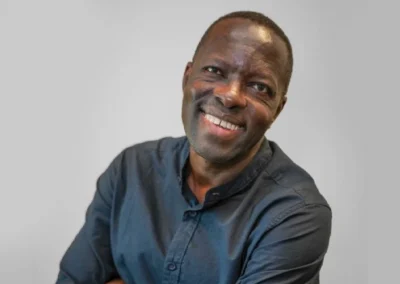
When Lillian Mworeko reflects on her path to becoming an influential voice for women and people living with HIV, she returns to the very beginning of her journey – as a young woman in her twenties who faced barriers and discrimination because of her status.
For instance, Lillian experienced stigma each time she traveled to the U.S. during the period (1997-2008) when people living with HIV who wished to enter the US were required to obtain a special waiver that required the open disclosure of their HIV positive status. Despite presenting the required waiver, an American immigration officer would pull her out of the passport control line for further scrutiny, also known as secondary immigration. “I was just always held for hours in a room, not allowed to call anybody, and it felt really stigmatizing, and I felt a lot of discrimination because of my HIV status,” she said. When UNAIDS later put together a high-level committee to review HIV-related international travel restrictions, Lillian served as a member and shared with the committee her story and the stories of others who had endured similarly humiliating immigration experiences. By bringing the human dimension of the travel stories to the attention of the committee, Lillian helped to bring about the removal of HIV-related travel restrictions by the US, China and other countries.
Another defining moment for Lillian came in 2003, during the formation of the National Forum of People Living with HIV in Uganda (NAFOPAHNU). At the first meeting, attended by 53 people, only a handful had access to HIV treatment. According to Lillian, a friend had donated a small supply of antiretroviral medications, enough to support only seven people, and the group had to choose who would receive the lifesaving treatment. “When we all had to unanimously agree on which seven people out of the 53 were to start treatment, I said to myself, somebody has to do more to advocate for us! We didn’t have money or experience, but we had stories, and stories could help contribute to the conversations, the discourse, the dialogue.”
Lillian’s advocacy mobilized other groups in the community network, such as Uganda’s early treatment literacy initiatives, and in 2005, she helped establish the International Community of Women Living with HIV Eastern Africa (ICWEA). ICWEA is a regional HIV advocacy network that supports women’s reproductive health rights. “Forming ICWEA was one way of making sure that we mobilized as a community and that we were able to respond to the realities that we faced.”

Lillian giving opening remarks on behalf of recipients of care at the opening dinner of the CQUIN 9th Annual Meeting.
Her journey has been about “advocating for access to treatment for PLHIV and representation in policy and decision-making platforms.” She also champions the rights of adolescent girls, young women, and key populations – groups she warns will suffer most under current global funding constraints. “It is going to be a vicious cycle of problems, challenges, and issues for women and girls, if we don’t find sustainable solutions to HIV care.” Yet she remains hopeful because communities have always been the backbone of the HIV response.
Receiving the Peter Preko Leadership Award
When she learned CQUIN had selected her as the inaugural recipient of the Peter Preko Leadership Award, which honors the memory of the late principal investigator and project director for CQUIN, who passed away in February 2025, Lillian was overwhelmed with mixed emotions. “I thought I would be excited, but the excitement was short-lived, because too many things went through my mind.”
Memories of Peter, his diplomacy, humor, and humanity, flooded in. “I felt so bad that we had to lose Peter at a time when we needed him most,” she said. She wondered whether she could carry even “a little bit of what Peter had,” noting, “I’ve never been diplomatic like Peter.”
But then a realization came: “Peter loved community. Peter loved us.”
That clarity reshaped how she viewed the award. “I think… Peter would have probably loved the award to go to a community person.”
Still, the responsibility of the award weighs heavily on her as she hopes to carry forward what he believed in most – meaningful community engagement.
Lillian’s leadership is grounded in one guiding principle: “Nothing for us, without us!”
“Anytime I’m going to make a decision, I must make sure that I carry the people and their needs and priorities.”
On the final day of the CQUIN 9th Annual Meeting, in Durban, South Africa, Lillian received the inaugural award. The recognition followed several weeks of deliberation and the evaluation by a six-person committee of a competitive pool of two dozen nominations.
“We want to honor Peter’s legacy of collaboration, community building, innovation, and commitment to sustainable HIV care,” said Maureen Syowai, CQUIN/HIVE program director. “Lillian’s decades-long advocacy, her unwavering defense of women’s rights and people living with HIV, and her insistence that communities must be centered in every decision reflect that spirit fully,” said Jessica Justman, ICAP’s senior technical advisor and CQUIN principal investigator at the meeting.
Asked how she hopes people will remember her, Lillian answered without hesitation: “I want to be remembered for fighting for community. When I sleep, when I wake up, I’m thinking about community.” Lillian hopes that her legacy will honor Peter Preko and reflect a life devoted to community building and leadership.