In 2025, members of the CQUIN network learned critical lessons about the vulnerability of each country’s HIV service delivery and monitoring and evaluation (M&E) systems – lessons that have been compelling them to adjust course and set new priorities for their countries’ HIV programs. At the forefront of these lessons was a CQUIN national HIV M&E system assessment across all 21 member countries, which revealed that 76 percent of M&E functions are partly or fully supported by external donors. These findings, in the context of sustained declines across many countries in HIV testing, antiretroviral therapy (ART) initiations, pre-exposure prophylaxis initiations, and tuberculosis preventive treatment, set the stage for CQUIN’s April 2026 meeting in Nairobi — three days dedicated to the practical work of adapting HIV programs toward country ownership and sustainability of their HIV programs.
From April 20 to 22, 2026, CQUIN, in partnership with Kenya’s National AIDS and STI Control Program, convened more than 260 participants in Nairobi, Kenya, including representatives from the 21 ministries of health in the network, recipient-of-care organizations, civil society, and global partners. Informed by the theme, “Works in Progress: Transforming the HIV Response in a Time of Change,” the meeting focused on four priority areas shaping the future of HIV programs: integrating HIV services into routine health systems; adapting M&E systems and reducing vulnerability to external funding shifts; safeguarding HIV service coverage and quality for key and vulnerable populations; and strengthening prevention and treatment services for advanced HIV disease.
“2025 has been a pivotal year for the CQUIN Network,” said Maureen Syowai, MBChB, MSc, CQUIN/HIVE program director, in her keynote. “We have learned how deeply external support is woven into the M&E systems and the service delivery platforms countries have built — and how exposed those systems become when that support shifts. CQUIN’s role this year has been to support countries in prioritizing, planning, and adapting their HIV programs to the current context. The April meeting is part of that ongoing work.”

Works in Progress
Opening the meeting on behalf of Kenya’s Cabinet Secretary for Health, Dr. Ouma Oluga, principal secretary, the State Department for Medical Services at the Kenya Ministry of Health, described how Kenya is aligning its HIV response with the country’s broader move toward universal health coverage, so all Kenyans can access quality health services when and where they need them, without suffering financial hardship. Four recently enacted health laws are reshaping how Kenya runs its overall health system. HIV services are being built into that system rather than running in parallel to it. His remarks set the tone for the meeting’s focus on redesigning HIV services within primary health care structures to ensure long‑term sustainability.
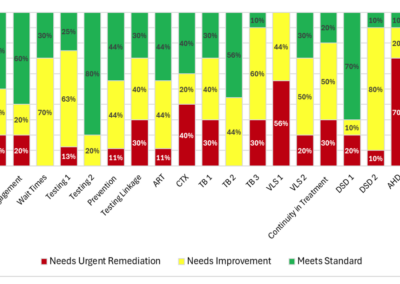
Across the network, similar redesign efforts are underway. In a plenary session on integration progress, representatives from Nigeria and Kenya shared results from the pilot of CQUIN’s latest Integration Capability Maturity Model, a self-assessment tool that countries use to identify strengths and gaps in integrating HIV services into routine primary health care. The results revealed a consistent pattern: while countries have made the most progress on policy development and planning, facility-level implementation, laboratory and pharmacy integration, and the quality of services for key populations remain the least mature areas of integration.
In a plenary session on the shifting M&E environment, three country teams shared case studies illustrating different pathways. Zimbabwe’s team shared a model in which the government leads M&E but still relies on partners for several core functions. Kenya’s team described efforts to move from fragmented data systems to a single, integrated one. Presenters from Senegal, in contrast, highlighted persistent gaps in monitoring services for key populations – gaps made more visible and more vulnerable by donor dependence.
Country teams also discussed advanced HIV disease, which remains a significant driver of HIV-related mortality despite progress on testing and treatment. The Uganda team shared how the country is sustaining advanced HIV disease (AHD) monitoring within its integrated national health information system, and Union Congolaise des Organisations des Personnes vivant avec le VIH (Congolese Network of Organizations of People Living with HIV), described how, in the Democratic Republic of Congo, community-led monitoring is being integrated into AHD services to strengthen early detection, follow‑up, and accountability.
Participants from all 21 member countries – together with global and regional partners – took part in a tabletop exercise to review the proposed list of 25 AHD cascade indicators, and each table reached consensus on whether to keep, modify, or drop each indicator. A total of 251 results were posted, and the pattern was clear: 88 percent of the indicators were kept, signaling strong confidence in the overall framework. The exercise also underscored a broader message – that countries need stronger, more resilient national M&E systems to track AHD consistently and meaningfully as external support shifts.
Throughout the meeting, discussions returned time and again to a central question: what does redesign look like in practice when communities are not just recipients of care, but the foundation of the system?


Bactrin Killingo, consultant with the International Treatment Preparedness Coalition, gave concrete examples of communities sustaining services despite funding disruptions. Peer networks in Kenya and South Africa have helped preserve antiretroviral therapy continuity, while community-led monitoring in Malawi and Zambia has supported real‑time problem‑solving and kept treatment on track. “Communities are frontline responders, detecting things early,” he said during his presentation. “Community-led monitoring is essential for accountability and real-time decision-making. We need to lay the foundation for the future system by institutionalizing community-led monitoring, financing it, and embedding it into national decision-making. We need to move from engagement to core implementation.”
In the closing keynote, Solomon Wambua, national coordinator of the Key Populations Consortium of Kenya, emphasized that integrating key population services into public systems must not come at the expense of the community-led platforms that have made those services accessible and trusted in the first place. “Community trust is the foundation of integration. We all rely heavily on trust and the safety of the environments we work in. Governments need to consider decriminalizing key populations. We know the drop-in centers for key populations are not just about medication. There’s a value add,” he said.
At the Tools Lab, country teams shared the practical work of redesign. Rwanda’s team demonstrated the country’s “eBuzima” electronic medical record system, including new modules for key populations and pre-exposure prophylaxis. Kenya’s team presented its Key Populations Transition Standard Operating Procedures, which guide the integration of key population services into the public health system while preserving community-led delivery. Tools from Mozambique, Uganda, Nigeria, Côte d’Ivoire, and partners such as the IAS were also shared.
Looking Ahead
Each country left Nairobi with an action plan that showed shared priorities across the network: implementing national integration frameworks, connecting electronic medical records and health management information systems, building health workforce capacity, and reorganizing service delivery so HIV care sits within chronic care or primary health care. While countries are at different stages in this transition, CQUIN will tailor its support to meet each country where it is.
The post-meeting evaluation, completed by 126 participants from 21 countries, showed strong intent to follow through. All respondents said they were likely to apply what they had learned within the next 12 months, with 85 percent saying they were “very likely” to do so.
“The meeting confirmed what we already knew: the transition ahead is going to be longer and harder than any of us would prefer,” said Jessica Justman, MD, CQUIN principal investigator and senior technical director at ICAP. “The work that countries have done in the past year — adapting, prioritizing, holding services together — gives us confidence in what comes next. CQUIN’s role is to keep that work supported and connected.”
As countries move from planning to implementation of their action plans, CQUIN will continue to support member countries through technical assistance, cross-country learning, and tool development, and foster a resilient, integrated, and sustainable HIV response in the years ahead.