When a six-person delegation from Senegal’s Ministry of Health, led by Magatte Ndoye Ndiaye, Chef de la Division Sida et des IST, arrived in Kenya for a learning visit, they came with a specific question: how do you build a national response to advanced HIV disease (AHD) and make it work?
Kenya had the answers.
From April 22 to 24, 2026, Kenya’s Ministry of Health and the National AIDS and STI Control Program (NASCOP) hosted the delegation, which visited health facilities in Nakuru and Nairobi Counties. CQUIN’s Moses Bateganya, MD, MPH (CQUIN deputy director, technical), Rachel Mudekereza, MD (CQUIN senior regional clinical advisor), and Marline Jumbe-Kumbe, MPH (CQUIN monitoring and evaluation regional advisor) supported the visit.
With a large HIV burden of 1.38 million people living with HIV and 21,007 AIDS-related deaths in 2024, Kenya has developed a robust and integrated national AHD model. Senegal, by contrast, with an adult HIV prevalence of 0.4 percent, has around 48,000 people living with HIV, of whom 79 percent are receiving ART. In addition, Senegal is one of only four countries in West and Central Africa where new HIV infections rose between 2010 and 2024, increasing by 36 percent over the period.
Kenya’s National Framework
The visit began on April 22 with a briefing from NASCOP on Kenya’s AHD policy and program priorities, guided by the country’s 2026 Integrated Guidelines for Prevention, Treatment, and Management HIV, STIs, and Viral Hepatitis. An AHD subcommittee oversees implementation of the guidelines, coordinating clinical, laboratory, and program teams through multidisciplinary technical working groups.
NASCOP also shared that, to equip its workforce, the country developed a standardized three-day, 13-module curriculum in AHD clinical management on diagnosing opportunistic infections, initiating rapid antiretroviral therapy treatment, and caring for critically ill patients, and has trained more than 1,500 healthcare workers in AHD so far. The curriculum is now also offered as a self-paced course through the Ministry of Health Virtual Academy, and Kenya has active AHD Centers of Excellence in 39 of Kenya’s 47 counties.
Nakuru County Referral Hospital: A Center of Excellence Advancing the Western Region Hub-and-Spoke Model for AHD Services
The delegation’s April 23 visit to Nakuru County Referral and Teaching Hospital (NCTRH) focused on what an integrated AHD response can produce. NCTRH has cut HIV-related inpatient mortality from 50% before integration to 14% in 2025–2026—a 36 percentage-point decline— the result of integrating a previously standalone HIV clinic into routine outpatient care, comprehensively training staff on AHD care across the outpatient and inpatient settings, and using data to guide decisions.
Presenters at NCTRH walked the delegation through how Nakuru achieved its success.

The Senegal delegation during the briefing at Nakuru
The county built a decentralized hub-and-spoke model for AHD services: four hub facilities, with NCTRH at the center, support about 170 spoke sites across 11 sub-counties. The hubs anchor specialized AHD care — diagnosis of opportunistic infections, complex case management, mentorship — while the spokes deliver day-to-day services closer to where people live. Community health promoters and other recipients of care who are doing well on treatment, known as expert clients, hold the system together at the community level, tracing recipients of care who interrupt treatment before they progress to AHD.
TB-HIV integration sits at the center of NCTRH’s AHD model since TB is the leading cause of mortality among people living with HIV in Kenya. In Nakuru, approximately 22% of PLHIV are co-infected with TB, and nearly 70 percent of TB-related deaths in the county occur among people living with HIV. To address high mortality through improved diagnostics, the county has rolled out AI-supported chest X-ray screening, intensified community- and facility-based TB screening, and put all eligible recipients of care on TB preventive therapy. More than 3,800 community health promoters have been trained on TB-HIV modules. Recipients of care with AHD or interrupted treatment are flagged for community follow-up.
For Dr. Bateganya, what the delegation saw at NCTRH was bigger than AHD alone. “The visit showcased not only AHD but the successful integration of HIV into routine health care at a regional referral hospital, something the county lead said would not have been possible without CQUIN and the AHD Capability Maturity Model staging the county embarked on,” said Dr. Bateganya. “The resulting reduction in mortality is one of the best examples of the impact of CQUIN.”
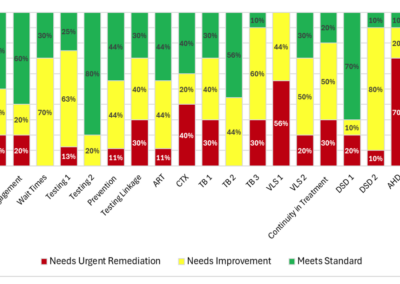
Dr. Jack Nyaliech, who co-chairs the AHD Technical Working Group for the South Rift Valley region that includes Nakuru, also described Nakuru’s turning point: “The CQUIN AHD Capability Maturity Model self-staging was a true wake-up call for our national HIV program,” he said. “It provided an honest reflection of where we stood, particularly highlighting domains that needed urgent strengthening. The improvements we are seeing now are a direct result of that process.”
An Urban Center of Excellence at Mbagathi
The delegation’s final stop on April 24 was at the Mbagathi County Referral Hospital in Nairobi, an AHD Center of Excellence that tells a different story than Nakuru’s. Here, the challenge isn’t just keeping people alive long enough to start treatment. It’s caring for them once they are living longer because of treatment. Mbagathi manages about 4,725 recipients of care on antiretroviral therapy treatment, including a geriatrics clinic for nearly 1,000 older adults living with HIV. To meet the needs of older recipients of care, the facility has integrated HIV, AHD, geriatrics, mental health, and non-communicable disease services into its Comprehensive Care Clinic – what Kenya calls its stand-alone HIV clinics. This is in recognition of the fact that people with HIV on antiretroviral therapy are living longer and need coordinated chronic care.

Participants listening to a briefing about the Mbathani facility
Supporting integrated care at Mbagathi takes the effort of a multidisciplinary team: clinicians, peer educators, adherence counselors, mentor mothers, community health promoters, nutritionists, and social workers. Peer educators and AHD champions — some with personal experience of advanced HIV — play a critical role in tracing recipients of care who have interrupted treatment, visiting their homes and linking them to community support through partners like AFROCAB, a pan-African network of community HIV treatment advocates.
The Care Clinic’s electronic medical record (EMR) system includes an early-warning system for AHD: it flags high viral loads, treatment interruptions, and low CD4 counts so clinicians can intervene before patients deteriorate. Although inpatient services currently rely on paper-based records for documentation, a phased transition, spearheaded by the Ministry of Health’s Digital Health Authority, is underway to deploy the Kenya TaifaCare EMR system in all hospitals as the national EMR platform for inpatient services.
Mbagathi, like many health facilities, lost staff during the February 2025 United States Government Stop Work Order period. Despite the reduced workforce, services continued, a testament to the committed staff and volunteers who work there. The transition of previously donor-funded, implementing partner-supported staff into county systems is now underway.
What the Senegal MOH team is taking home
By the end of the visit, the Senegal delegation had a clear list of what they wanted to adopt: multidisciplinary capacity building, post-discharge follow-up systems, decentralized hub-and-spoke coordination, peer educators and community systems, routine mortality audits, and real-time data for clinical decision-making. The team plans to start with an AHD training needs assessment and to develop a national AHD implementation and monitoring framework. Nakuru County’s team has also agreed to share its experience with the broader CQUIN network in a webinar. “We are deeply grateful to the Kenya Ministry of Health, NASCOP, and CQUIN for an exceptionally well-coordinated learning exchange,” said Sira Barry, HIV Care and Treatment lead, Ministry of Health, Senegal. “The site’s preparedness, warm hospitality, and openness in sharing knowledge were truly admirable. This experience has inspired us to move forward with an actionable plan to strengthen AHD services and M&E.”

The Senegalese delegation, together with the team from Kenya and CQUIN, outside the Nakuru facility.