Until recently, countries in the CQUIN network lacked a common standard for measuring HIV service quality. Different country programs used different tools, making assessments and results across facilities and countries hard to compare.
As HIV program budgets tighten and services become more integrated into routine primary health care, countries across the CQUIN network need reliable, comparable data to track service quality.
CQUIN’s new HIV Program Minimum Package Service Quality Assessment (SQA) Toolkit addresses that gap.
“Some countries were using PEPFAR’s tools, some were using CQUIN assessment tools, others had merged the two or had their own national tool,” said Onyekachi Ukaejiofo, MD, CQUIN regional clinical advisor and quality management lead. “Each made sense on its own, but the results couldn’t consistently be compared from one facility to the next, let alone across countries.”
Developing a Harmonized Tool for the Network
To address this fragmentation, CQUIN’s Quality Management Community of Practice surveyed all 21 network countriesto map the tools already in use. The review confirmed that every country assessed service quality in some form, but rarely in a way that could be compared within the country or across the network. Drawing on what the different tools had in common, CQUIN and ministry teams identified a core set of measures every HIV program should track, which formed the foundation of the new toolkit’s 24 standards.
A Look at the Toolkit
The toolkit has three components designed for country adaptation:
- Standard Operating Procedures provide step-by-step guidance on administering the tool, scoring results, interpreting data, and using findings for quality improvement and planning.
- The HIV/TB Minimum Package SQA Facility Tool is a structured questionnaire that assesses 24 standards across the HIV care cascade, including HIV testing and prevention, linkage to treatment, ART, viral load suppression, continuity in treatment, differentiated service delivery, advanced HIV disease, vertical transmission prevention, and TB services. The tool also assesses cross-cutting standards such as stigma and discrimination, community engagement, waiting times, and supply chain. Each standard combines policy and process checks with reviews of actual client records, so the scores reflect what is happening at the point of care.
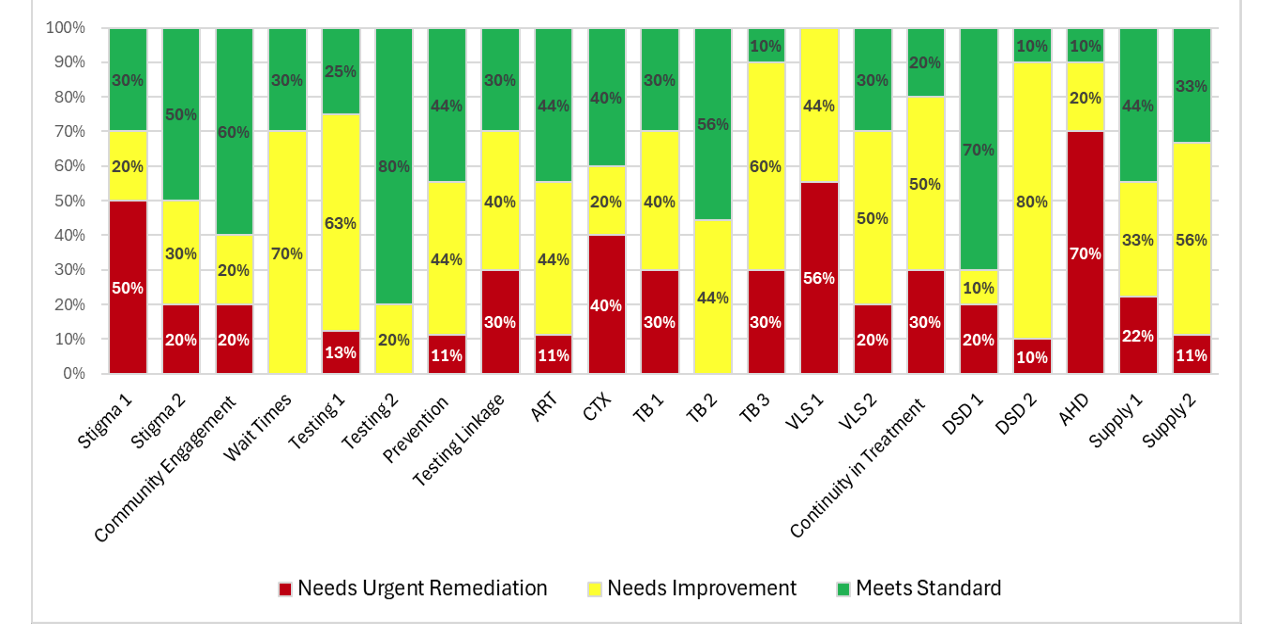
- The SQA Summary Tool is a companion workbook that aggregates facility results into visual dashboards, giving national and sub-national planners a clear picture of where quality is strong and where it needs attention. Each standard is scored at every facility and rolled up to a national picture: green means the standard is being met, yellow means it needs improvement, and red signals a need for urgent remediation. CQUIN is finalizing a version compatible with , a health information platform used by many countries, to allow facility data to flow directly into countries’ own systems.
Designed for Country Adaptation
The toolkit was developed over 18 months, during a period of significant change in the global HIV funding environment. After the U.S. government paused foreign assistance in early 2025, countries and partners had to reassess program priorities and respond to disruptions affecting PEPFAR- and USAID-supported activities.
Against that backdrop, the toolkit underwent piloting, technical review, and several rounds of refinement before the Quality Management Community of Practice introduced it to network countries during a June 30, 2026, webinar.
“One of the strengths of the toolkit is that countries can adapt it to their national guidelines and priorities. The goal is actionable evidence that ministries can feed directly into sustainability planning and continuous quality improvement, rather than findings that sit in a report,” Ukaejiofo said.
Early Results from the Field
Ghana was among the first countries to pilot the toolkit.
The Ghana National AIDS/STI Control Program had been running a separate quality assessment for each service area: one for ART delivery, another for HIV testing, another for advanced HIV disease, plus client satisfaction surveys and audits.
“All of these were separate and quite cumbersome until we were exposed to the CQUIN harmonized service quality assessment tool, which brought all of these together for us,” said Dr. Raphael Adu-Gyamfi, senior program officer at the program.
Before assessing any facilities, Ghana worked through adapting the tool with its regional HIV coordinators to make sure it fit the national context and aligned with existing indicators, then had three regions pilot it and provide feedback to CQUIN to refine the tool. The assessment was designed to build ownership so that, rather than relying on external evaluators, each facility’s own quality improvement team led its assessment through record reviews and interviews with health workers and clients, while regional and national teams validated the results against national data systems.

A panel discussion considered the SQA toolkit during a webinar on June 30
Ghana presented its experience at the June webinar. The Ghana MOH assessed 234 facilities against the 24 HIV/TB service quality standards. Nationally, 13 of the 24 standards
met the required threshold, while the scores flagged 10 for improvement; one standard was not applicable under national policy. But the real value came from the facility‑level breakdown. On community treatment, for example, Ghana scored green overall, yet the facility-level breakdown showed that more than a fifth of the 234 facilities assessed scored red on that standard. The breakdown helped the MOH identify specific facilities needing support to target its interventions.
That clarity is now driving action. Ghana is using the findings to shape the priorities in its Global Fund grant application and to underpin a request for UNICEF support — which was granted — to strengthen services that prevent vertical transmission of HIV. The same data is guiding national training, informing the protocols and registers facilities use, and setting the criteria for the country’s annual facility awards.
Nigeria, the second pilot country, took a different route to the same goal by folding the assessment into the routine site visits that national clinical mentors already make. The country’s health teams have used the SQA tool in 20 facilities, with plans to reach about 200 facilities, demonstrating that the toolkit can fit seamlessly into existing systems and reduce burden.
What’s Next?
Eleven Phase One countries are now implementing the SQA. Burundi, Ethiopia, Lesotho, Liberia, Nigeria, Mozambique, Senegal, Sierra Leone, South Africa, Uganda, and Zambia are expected to share their results by mid-September ahead of CQUIN’s 10th annual network meeting in December 2026, where multi-country results will allow comparison of quality performance across standards and maturity levels.
“Quality improvement advances when leadership has clear, trusted data in front of them,” said Maureen Syowai, MBChB, MSc, CQUIN program director. “A harmonized assessment gives ministries a single, comparable picture of service quality. Countries benefit enormously from seeing how their performance stacks up within their own context and across the network. It creates accountability, accelerates learning, and gives leaders the confidence to act and for a network built on countries learning from one another, it is more efficient when everyone is measuring the same things, the same way.”
The full toolkit is available on the CQUIN Resources page in English and French. Ministry teams with questions about adapting or administering the tool can contact CQUIN at icap-cquin@cumc.columbia.edu.