Recent global changes have introduced sweeping shifts in foreign aid disbursements and funding priorities, placing increased pressure on national health programs to maintain critical services in the face of uncertainty.
For many countries, the disruption of external funding necessitates a rethinking of what constitutes a sustainable, minimum core package of HIV/TB care—one that can deliver safe, efficient, and client-centered care. The CQUIN Quality Management CoP provides a platform for sharing cross-country strategies for adapting, maintaining, and scaling core services under constrained resources. Building from the foundational work of the previous Quality Management CoP, cross-country learning and peer support will continue through webinars, case studies, and virtual learning sessions. CQUIN amplifies innovations, success stories, and common challenges.
The Quality Management CoP has prioritized the following key strategies in 2026:
- Define and refine core minimum HIV/TB quality standards
Through the collaborative process, members will establish a set of evidence-based quality benchmarks for a minimum set of HIV and TB care services (e.g., testing, linkage, ART, TB preventive therapy, and advanced HIV disease management).
- Exploring modular expansions (e.g., advanced HIV disease, TB preventive therapy) that are triggered when core standards are unmet.
- Develop and validate assessment tools
The CoP co-creates practical tools (e.g., service quality assessments (SQA) and toolkits) to assess whether service delivery settings meet these core standards, and to identify gaps.
- Pilot adaptations and context-specific modules
Recognizing diversity across countries and settings, we support country teams to adapt the minimum quality package and deeper modules (for TB/HIV, advanced HIV disease, etc.) to local contexts.
- Centering Quality and Community Voice in Sustainability
As funding landscapes evolve, sustaining progress requires more than maintaining services—it requires systems that reflect community priorities and uphold quality as a core commitment. The CoP works to ensure these principles are woven into the fabric of national budgeting, governance, and implementation processes.
Group discussions at a June 2025 meeting, led by Gillian Dougherty, Quality Management CoP lead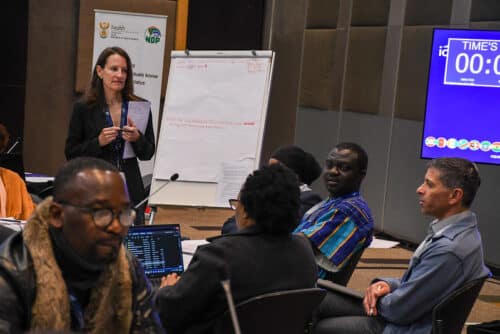
Background
Launched in October 2018 with participation from 20 countries and global stakeholders, the Quality Management Community of Practice (CoP) focused on strengthening capacity for differentiated service delivery (DSD)-specific quality management. Early activities included developing DSD-specific quality standards, indicators, and quality assurance (QA) tools, as well as sharing resources to support quality improvement (QI) initiatives across countries. The CoP also tracked progress using the CQUIN Capability Maturity Matrix (CMM) and service quality assessment tools to guide and evaluate implementation.
Activities
- In 2023, the quality management, recipient of care, and M&E community of practices co-created a recipient of care satisfaction decision matrix and toolkit.
- In April 2022, CQUIN hosted the second Quality Management workshop, where network countries shared progress in their quality management journeys, including showcasing examples of national DSD quality standards, quality assessment data, and quality improvement projects. Additionally, the quality management, recipient of care, and M&E community of practices have co-created a recipient of care satisfaction decision matrix and toolkit to provide network countries with best practices for assessing and improving recipient of care satisfaction.
- In 2021, the CQUIN Quality Management for DSD Programs community of practice developed a quality assessment toolkit for DART models. The tool was pilot tested in three countries and is intended to serve as a complementary resource for stakeholders to assess and improve DART quality. Network countries are actively adapting the standards and assessment toolkit to their local contexts.
- In 2020, the community of practice responded to the lack of global and national quality standards for DSD by co-creating a DSD quality standards framework for less-intensive DART models; the English version is here, and the French version is here.
- In June 2019, CQUIN hosted an all-network workshop on DSD Quality and QI, and the network continues to explore each of the three elements of the classic “Juran Triad” as they relate to DSD – quality planning, quality assurance, and quality improvement.
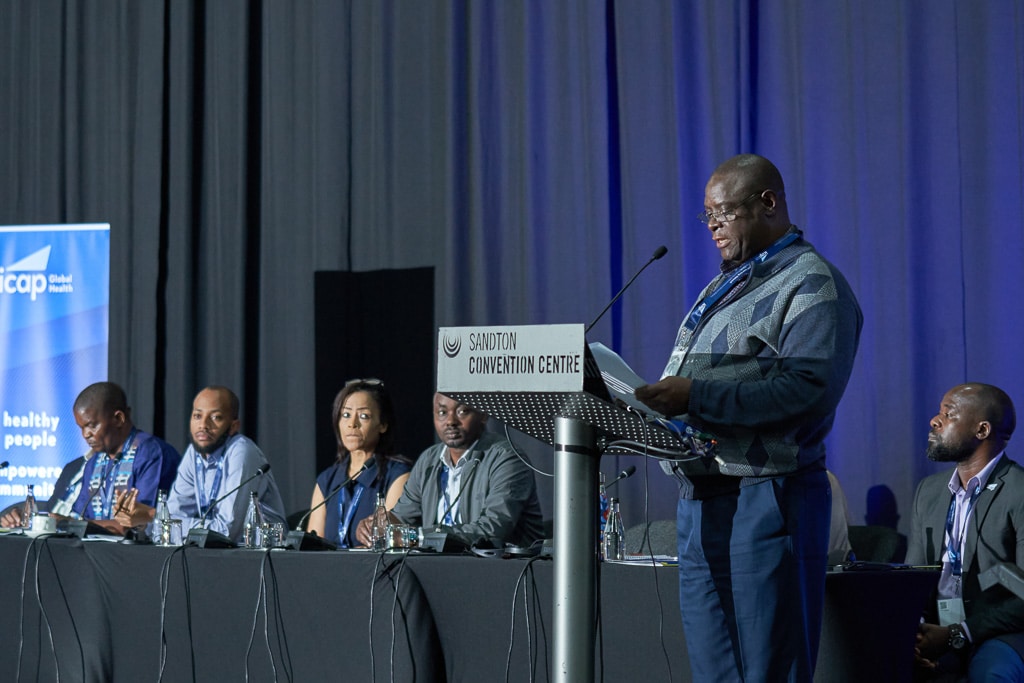
Jimmy Gamma, USAID Malawi, giving a presentation at the CQUIN 7th annual meeting in a breakout session on the Quality CoP
Resources
The Quality Management CoP is supported by Gillian Dougherty, deputy director for HRH (gd2410@cumc.columbia.edu), Onyekachi Ukaejiofo, CQUIN regional, clinical, and quality improvement advisor (ou2122@cumc.columbia.edu), Ms. Tengetile Magagula, regional operations coordinator from ICAP in Eswatini.